

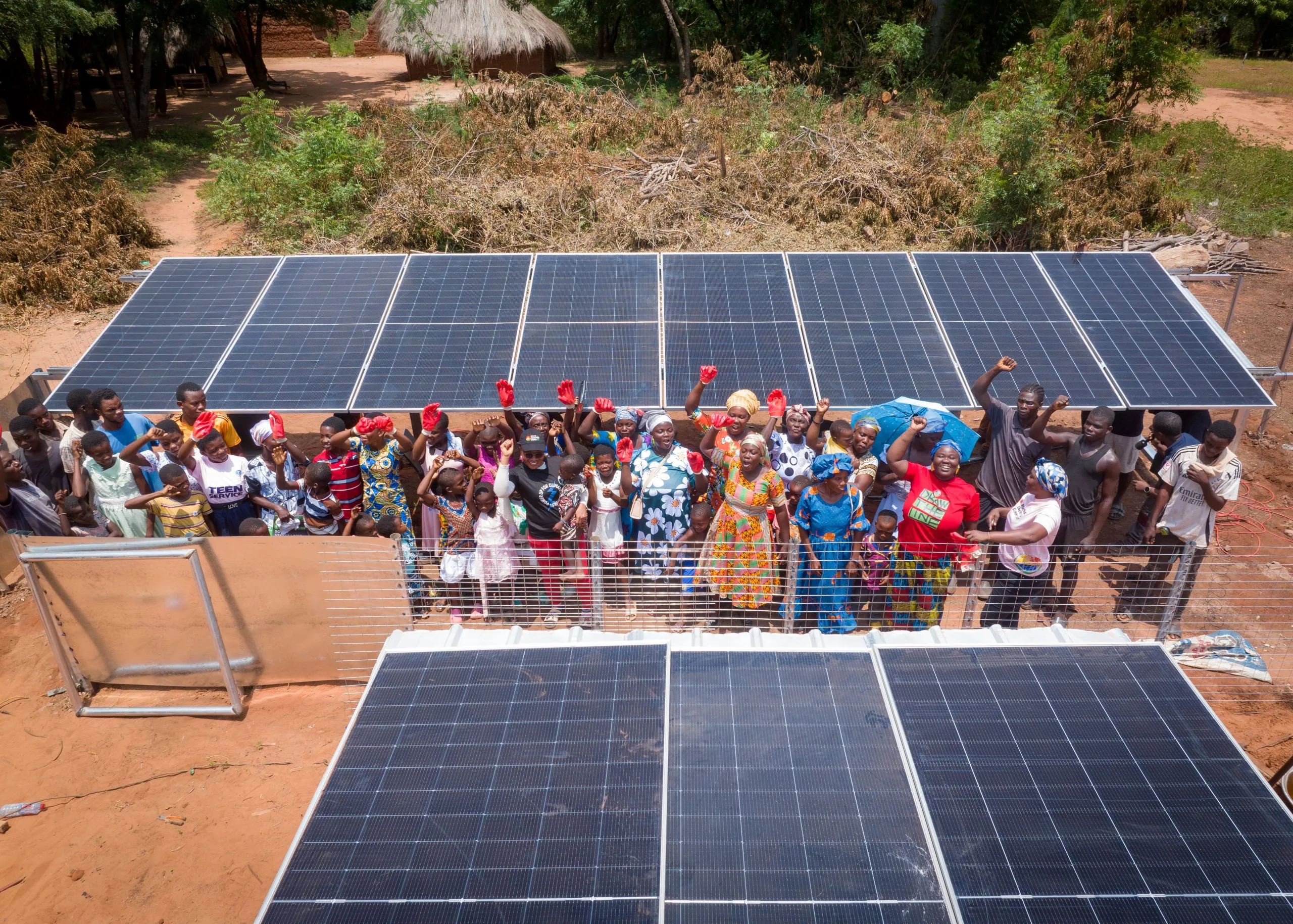
APAASO, Eastern Region, Ghana – For more than six decades, the story of Apaaso has been closely connected to Ghana’s electricity history. The community was established as a resettlement community for people displaced by the construction of the Akosombo Dam on the Volta River.
Today, Apaaso is entering another chapter in that history — this time through a community-owned approach to renewable energy.
Thirty-six households in Apaaso, in the Asuogyaman District of Ghana’s Eastern Region, now have access to basic electricity services following the completion and inauguration of a solar-powered micro-grid developed through the 350 Ghana Reducing Our Carbon (350GROC) initiative.
The project, known as #Apaaso4Solar, brings together solar power generation, battery storage and a local electricity distribution system designed specifically around the basic energy needs of participating households.
The inauguration marked more than the installation of solar panels. It demonstrated how decentralised renewable energy can be taken directly to communities and used to address energy-access challenges while contributing to Ghana’s transition towards cleaner energy.
According to 350GROC, the project reflects its broader vision of an energy transition that is renewable, affordable, decentralised, accessible and people-centred.
From a community shaped by Ghana’s power history to a community generating solar power
Apaaso is located near Gyakiti in the Asuogyaman District of the Eastern Region.
The community’s history is particularly significant because its establishment was connected to the construction of the Akosombo Dam more than six decades ago. The dam became one of Ghana’s most important electricity infrastructure projects, but its construction also resulted in the displacement and resettlement of communities.
For Apaaso, the arrival of decentralised solar electricity creates a striking new chapter in that history.
Rather than relying solely on large-scale electricity infrastructure, the #Apaaso4Solar initiative demonstrates how a community-level renewable-energy system can provide essential electricity services directly to households.
The project therefore carries both practical and symbolic significance: a community whose history is linked to one of Ghana’s largest power projects is now part of a decentralised renewable-energy solution.
How the Apaaso solar micro-grid works
At the heart of the project are eight 615-watt bifacial solar panels, providing a total installed solar capacity of 4.92 kilowatt-peak (kWp).
The system has been designed around approximately five peak-sun-hours per day and an estimated 90 per cent system efficiency, resulting in expected daily electricity generation of approximately 20–22 kilowatt-hours (kWh).
During daylight hours, solar electricity can be used directly by participating households. When generation exceeds immediate demand, electricity can be stored in batteries for later use.
The system includes 10 kWh of total battery storage, consisting of two 5 kWh BYD lithium iron phosphate (LiFePO4) batteries, with approximately 8 kWh considered usable storage.
An 8 kVA Victron MultiPlus-II 48/8000 inverter manages the conversion and delivery of electricity through a 230-volt AC distribution network.
The battery-storage component is particularly important because solar panels do not generate electricity after sunset. Storing electricity during the day allows the community system to continue providing essential services at night.
Designed for basic energy access
The Apaaso system has deliberately been designed around basic household electricity needs, rather than unlimited electricity consumption.
During the day, households can use low-energy appliances such as mobile-phone chargers, small fans and radios, with household demand expected to remain within approximately 100–150 watts maximum.
At night, the main priority is lightening. The planned night-time lightning and other basic appliances demand approximate to 7.98kWh, covering 2pcs of 20W high energy efficient bulbs across each 36 households and an additional 2pcs of 30W LED flood lamps..
High-energy appliances such as refrigerators, electric irons, heating coils and water-pumping machines are not currently supported by the system.
These restrictions are part of the design philosophy of the project. By matching electricity demand to available solar generation and battery-storage capacity, the system can distribute limited energy resources more sustainably among participating households.
A project built around people, not only technology
For 350GROC, the success of a community micro-grid cannot be measured only by the number of solar panels installed or the amount of electricity generated.
Community participation is a central part of the #Apaaso4Solar approach.
During installation, residents supported the project team in preparing the site and installing the solar infrastructure. Women also played an active role in the community’s participation.
This community involvement is important for the long-term sustainability of the system. Residents need to understand the capacity and limitations of the micro-grid, use electricity responsibly and participate in decisions concerning maintenance and possible future expansion.
Speaking during the inauguration, Portia Adu-Mensah, National Coordinator of 350 Ghana, emphasised the importance of bringing renewable energy directly to communities and placing people at the centre of Ghana’s energy transition.
What electricity means for Apaaso families
For the 36 participating households, the impact of the project goes beyond technical specifications.
Electric lighting can enable children to study after dark, improve visibility and safety in homes, facilitate mobile-phone charging and strengthen access to information and communication.
In communities where reliable electricity access has been limited, these basic services can have significant effects on everyday life.
For 350GROC, this is where renewable energy intersects with energy justice and climate justice.
The organisation’s approach is that Ghana’s energy transition should not only focus on reducing greenhouse-gas emissions. It should also ensure that communities facing energy-access challenges can participate in and benefit from the transition.
#REPowerGhana: taking renewable energy to communities
The Apaaso project forms part of 350GROC’s broader #REPowerGhana campaign.
The campaign promotes an energy system in which communities are not simply consumers of electricity but active participants in Ghana’s transition towards renewable energy.
The #Apaaso4Solar project puts this principle into practice by taking renewable-energy infrastructure directly into a community and designing the system around its immediate needs.
It also demonstrates the potential of decentralised energy systems to complement Ghana’s wider electricity infrastructure.
Ghana’s renewable-energy pathway includes decentralised renewable-energy development and mini-grid systems, particularly as potential solutions for communities where extending conventional grid infrastructure may be technically difficult, costly or time-consuming.
350GROC’s wider renewable-energy work
The Apaaso project is part of a wider body of work by 350 Ghana Reducing Our Carbon, a grassroots renewable-energy and climate-justice movement working to accelerate Ghana’s transition away from fossil fuels and towards renewable energy.
Through its campaigns and community initiatives, 350GROC has promoted renewable energy as a practical pathway for reducing emissions while expanding access to clean energy.
Its work includes advocacy for renewable energy for communities and schools, women in renewable energy, solar solutions for underserved communities, and greater public participation in Ghana’s energy transition.
The organisation’s Renewable Energy for Communities (RE4C) campaign has promoted affordable and decentralised renewable-energy solutions, while its Renewable Energy for Schools work highlights the importance of bringing clean energy and climate education into educational institutions.
Its community-based approach has also included solar-energy interventions designed to demonstrate how renewable energy can support households, education, livelihoods and local development.
The organisation’s campaigns have consistently linked renewable energy with participation, justice and community empowerment rather than treating energy transition as purely a technical or infrastructure issue.
The Apaaso micro-grid therefore represents a practical expression of this broader approach: start with communities, understand their needs, introduce appropriate technology and create opportunities for people to participate in the energy transition.
A foundation for future livelihoods
The current Apaaso system is primarily designed to provide basic household electricity services. But the project could provide a foundation for future expansion.
With additional investment in solar generation, battery storage and distribution capacity, the system could eventually support productive uses of electricity, including refrigeration, water pumping, agro-processing, small businesses and digital services.
Such expansion would need to be carefully planned because productive-use appliances generally consume significantly more electricity than lighting and phone charging.
Future growth would therefore require additional generation and storage capacity alongside any substantial increase in demand.
The long-term objective is to allow the energy system to grow with the community without placing unsustainable pressure on the existing infrastructure.
Why Apaaso matters to Ghana’s energy transition
Ghana’s clean-energy transition will require different approaches to meet different energy needs.
Large-scale renewable-energy projects will remain important, but decentralised systems can provide another pathway for communities located far from conventional electricity infrastructure or where grid extension presents challenges.
Solar micro-grids combine locally available solar resources, battery storage and community-level electricity distribution.
The Apaaso project provides a small-scale example of how such systems can complement Ghana’s wider electricity system.
At 4.92 kWp, the Apaaso installation is modest when compared with conventional power-sector infrastructure.
But the significance of the project is not determined by installed capacity alone.
Its importance lies in demonstrating that renewable energy can be designed around the specific needs of a community and delivered directly to households.
From darkness to light
For Apaaso, the arrival of solar electricity represents a practical change in everyday life.
A child can switch on a light to study.
A resident can charge a mobile phone at home.
Families can have improved visibility after dark.
Households can access basic electricity services without waiting for a large-scale power project to reach the community.
And the community can begin imagining what more reliable access to clean energy could mean for education, communication, livelihoods and future development.
For 350GROC, however, #Apaaso4Solar represents something larger.
It is a demonstration that Ghana’s energy transition can begin at community level with technology designed around people, local participation and the realities of energy access.
The 36 households of Apaaso may be receiving a relatively small amount of electricity compared with Ghana’s national power system, but the project carries a wider message.
The energy transition is not only about how much electricity Ghana generates. It is also about who has access to that electricity, who participates in creating solutions, and whether communities are able to benefit from the transition.
For Apaaso, that transition is now visible every evening when the sun goes down and the lights come on.
For 350GROC, it is another practical step towards #REPowerGhana a clean, affordable, decentralised and people-centred energy future.

